Posts

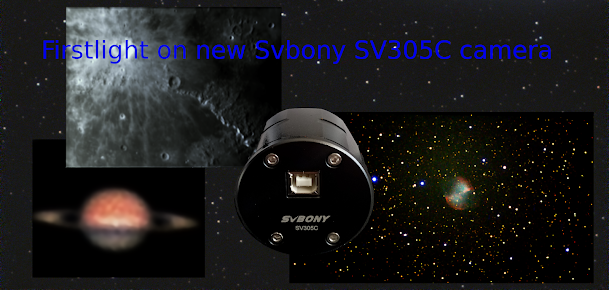
Svbony SV305C Camera first light on this new Camera (IMX 662 sensor)
Image
Greetings fellow astronomers.  I recently purchased the new Svbony SV305C planetary camera as a upgrade to my old T7C astro camera (ZWO ASI120 clone) which is now many generations old in terms of sensor technology.  This new camera is also a upgrade from the old Svbony SV305 camera which is based on the original Sony IMX290 sensor a best seller for sure.  The new  SV305C uses the relatively new Sony IMX662 sensor released in mid 2022.  The new Svbony SV305C camera has several new technologies built into the sensor such as backlight sensor technology which gets rid of amp glow so the image brightness is completely uniform ( Sony STARVIS 2 ).  The new IMX662 sensor also has a much lower noise floor compared to older sensors such as my old camera and the ZWO ASI120MC-S camera which both have the old ARC0130CS sensor (see figures 1 and 2 below actual dark frame images).  The new IMX662 sensor in the SV305C camera has a much higher fullwell capacity and b...

Imaging with a low end T7C camera (a ZWO 120 knockoff)

Image
Greetings fellow astronomers.  I am reviewing my first planetary camera I bought on a budget a year ago the T7C astro planetary camera .  I used my 102mm Mak for planetary imaging and my small Orion 80mm goscope for some deep sky imaging !  I have also updated this review with some recent images i took off Saturn and Jupiter with this camera in August of 2023 to show its capabiltity of this entry level budget planetary camera even with basic equipment and small telescopes. Of course I live in a bortle 7/8 city which limits the overall quality of the images and does not reflect to the cameras limits.. There is some good and not so good with this basic old camera.  The great part of this camera with the arc 130 sensor is the camera capture frame rate is very quick topping out in the lowest ROI modes at around 175 fps while planetary imaging even through it is usb2.  The high frame rate definitely definitely helps cut through atmospheric distortion and fast pl...